IPPFWHR Acquisition of IWHC and Change
See press release for details
IPPFWHR Acquisition of IWHC and Change
See press release for details
My article from 2006 on Margaret Sanger and Eugenics
The Pennsylvania Ballet announced their upcoming digital season a few days ago. The season is dedicated to their founder, Barbara Weisberger, who died in December. One might have thought that the company would feature ballets choreographed by women in her honor.
Nope. Not one.
Eleven choreographers. All male.
Men 11 – Women 0.
What were they thinking? Clearly they weren’t thinking.
What a lost opportunity to salute their female founder. What a kick in the face to women creators in ballet.
What are the women (and the good men) on the company’s board thinking? Are they going to let the male director get away with this?
Time for a reckoning.
Anthony Tommasini wrote an article in The New York Times this week (https://www.nytimes.com/2021/02/12/arts/music/american-orchestra-classical-music.html) on how orchestras need to reinvent themselves in our nation’s new environment. Scant mention was made of female composers, living and dead, being part of the solution – with only one mention of the New York Philharmonic’s Project 19, which commissioned works from 19 female composers, many of color.
It is no secret that under 3% (or 2% I’ve also heard) of music played by symphony orchestras in this country are written by women. The same is true worldwide. A huge percentage is by Beethoven, Mozart and Bach. A modern composer can mean Rachmaninoff who died in 1943. Commendable efforts are sputtering along to find African-American composers to play. The go-to African-American female composer last season has been Florence Price, who died in 1953.
As always, smaller ensembles, and venues like National Sawdust, are way ahead in this regard and didn’t need our national reckoning with race to spur their efforts at diversifying whose music gets played and who plays it. Why doesn’t every orchestra (and opera company) have a smaller ensemble that plays new music in different venues? The New York Phil Bandwagon was a great start, giving concerts in New York neighborhoods, including new commissioned works. Co-commissioning new works by living composers, male and female, of all ethnicities, can be a bridge to building community and understanding and new audiences. And it can spread the costs of a commission among several orchestras, while giving greater exposure to a new work that too often get a premier and die.
Orchestras need, like baseball teams, to build the farm system. They need to sponsor younger composers right out of conservatory, provide composer-in-residencies that would pair a young untried composer with a more experienced one and do repeated readings of their works so that the composer can get feedback and refine their compositions. And make recordings so that the new works can get greater exposure.
All it takes is vision, and will, and, yes, money. But the payoff can be multiples of the investment.
The newspapers reported last week that some Republicans are resigning from their party out of disgust with Trump and Trumpism. This is a mistake. It leaves the party in the hands of the fanatics. The sensible Republicans should stay and fight for their party.
Reproductive rights are in the ascendancy in the Western Hemisphere. The momentum in Argentina, where abortion up to 14 weeks was decriminalized at the end of December, is spreading to Chile, where advocates are working to get sexual and reproductive rights in the new constitution and to Colombia, where efforts are underway to take abortion out of the criminal code. These coupled with the repeal of the Global Gag Rule signals that progress is not impossible if the will and activism are there.
At some point, Republicans who believe that the government should not be in the business of regulating, controlling and subjugating women will take back control of their party. Polls show that about half of Republicans support Roe v. Wade. It will take these sensible Republican women and men showing the fortitude that women and men in Argentina showed. Politicians will cave once they realize they won’t be re-elected. These women should not be resigning from the Republican Party in disgust; rather than should recruit others to take it back from Trump and his misogny.
Excerpted from The Guardian
Argentina has become the largest Latin American country to legalise abortion after its senate approved the historic law change by 38 votes in favour to 29 against, with one abstention.
The bill, which legalises terminations in the first 14 weeks of pregnancy, was approved by Argentina’s lower house earlier this month after being put to congress by the country’s leftwing president, Alberto Fernández.
“Safe, legal and free abortion is now law … Today we are a better society,” Fernández celebrated on Twitter after the result was confirmed.
Fernández has previously said that more than 3,000 women had died as a result of unsafe, underground abortions in Argentina since the return of democracy in 1983.
The landmark decision means Argentina becomes only the third South American country to permit elective abortions, alongside Uruguay, which decriminalised the practice in 2012, and Guyana, where it has been legal since 1995.
Cuba legalised the practice in 1965 while Mexico City and the Mexican state of Oaxaca also allow terminations.
Giselle Carino, an Argentinian feminist activist, said she believed the achievement in the home country of Pope Francis would reverberate across a region that is home to powerful Catholic and evangelical churches and some of the harshest abortion laws in the world.
In most countries, such as Brazil, abortions are only permitted in extremely limited circumstances such as rape or risk to the mother’s life, while in some, such as the Dominican Republic and El Salvador, they are banned altogether.
“I feel incredibly proud of what we’ve been able to achieve. This is a historic moment for the country, without a doubt,” said Carino, head of the International Planned Parenthood Federation, Western Hemisphere Region.
“It shows how, in spite of all the obstacles, change and progress are possible. Argentinian women and what’s happening right now will have an enormous impact on the region and the world,” Carino added, pointing to parallel struggles in Brazil, Chile and Colombia.
Colombian activists recently petitioned the constitutional court to remove abortion from the country’s criminal code while campaigners in Chile hope a new constitution might lead to expanded women’s rights.
In the region’s most populous nation, Brazil, activists are waiting for the supreme court to rule on a 2018 legal challenge that would decriminalise abortion in the first weeks of pregnancy.
Mariela Belski, Amnesty International’s executive director in Argentina, called the result “an inspiration to the Americas”.
“Argentina has sent a strong message of hope to our entire continent: that we can change course against the criminalisation of abortion and against clandestine abortions, which pose serious risks to the health and lives of millions of people.”
Carino said the leftward political shift that brought Fernández to power had undoubtedly boosted the pro-choice campaign after the previous year’s setback. Among those who helped Fernández win office were many young women who took part in the #NiUnaMenos protests and were voting for the first time.
Carino said the real credit lay with Argentina’s indefatigable women “who never stopped occupying the streets and the social networks – not even against the backdrop of the pandemic – and kept up their struggle, without haste but without rest”.
“If anything made the difference, it was this.”
By Alexander Sanger
Mary Lindsay, former board chair of Planned Parenthood of New York City and hence my one-time boss, died on October 4, 2020 at age 100.
Not just indominable, she was unfailingly kind, thoughtful and gracious. As a leader at PPNYC, she was universally respected by her colleagues on the board and the staff. Being a nurse, she cared deeply about how we treated our clients and would walk through the clinics with an eagle eye open and her mouth shut, saving her comments for when we were alone. She knew the role of the board and that of the staff and would behave and lead accordingly. But for term limits, she would have been PPNYC’s board chair for decades.
Generous to PPNYC, she inspired her fellow board members and friends to be as generous as they could, again leading led by example. She chaired at least two capital campaigns, made the lead gifts and then solicited her friends to join her. She was inspiring for our common vision, and friends could not resist Mary’s call to be a part of building something larger than themselves. “I have learned it is a wonderful thing to have people give their money to something they believe in,” she once said. “I have also learned that if you do not ask for it, someone else is going to, and so you had better get there first.”
And coming from Republican stock, though she had become a Democrat, she was invaluable in lobbying and cajoling politicians and donors from the Republican side of the aisle and insured that the staff be nonpartisan in our communications, when it was so tempting to be otherwise. She joined with P.L. Harrison, Barbara Mosbacher and Barbara Gimbel, of the New York State Republican Family Committee, to lobby in Albany for family planning and abortion rights.
She came to PPNYC from the board of the Margaret Sanger Research Bureau, where she had first volunteered as a nurse and then became board chair after my father stepped down, and where she helped that organization merge into PPNYC. She and my father worked closely together and had immense respect for each other. She worked with PPNYC to incorporate the training of doctors and nurses from around the world in family planning into our clinical practice. This program, called the Margaret Sanger Center, brought the best in family planning training to practitioners serving the most needy women and men in the Third World. Mary loved to travel with PPNYC’s education staff, Peter Purdy, Shirley Oliver and Errol Alexis, to view and evaluate our far flung programs around the world.
Below is the list of the board and advisors of the Margaret Sanger Research Bureau before Mary became chair.


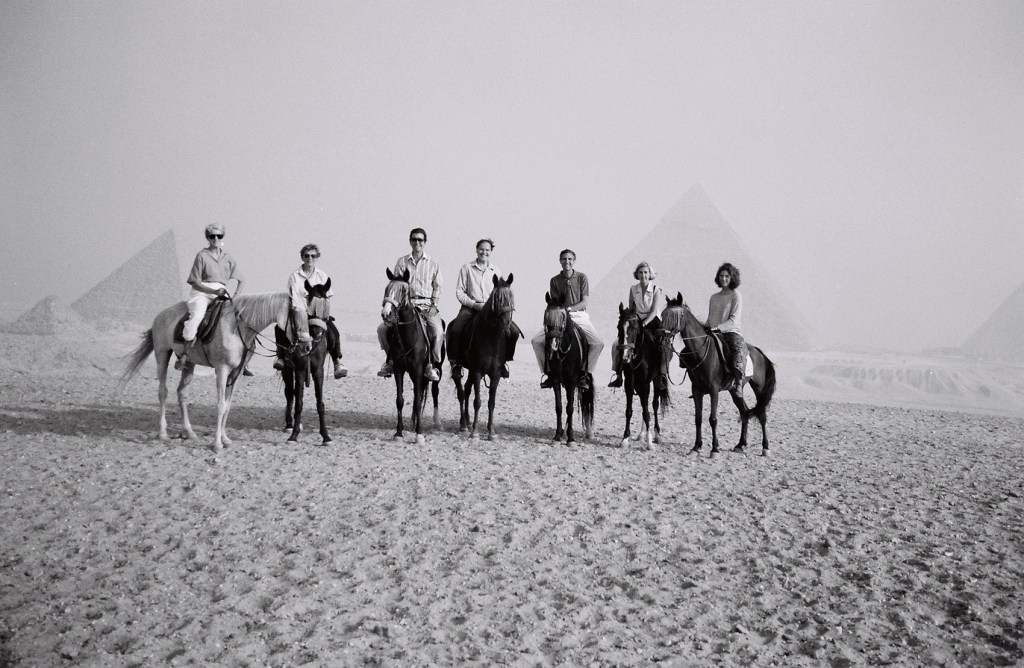
On the day after our panel, at Mary’s instigation, she and I, accompanied by Peter Purdy, the PPNYC Vice President for International Affairs and his wife, Susan, along with Peggy Kerry, a PPNYC advisor and sister of Senator John Kerry who was at the Conference, took a dawn horseback ride to the Sphinx and Pyramids. We had the desert to ourselves. No one of the other 20,000 delegates had the imagination or gumption to organize this mad venture. We rode across the desert in a gallop and saw the sun rise over the Pyramids as the day warmed. It was an experience we never forgot.
Mary was most interested in, as she said, “the rights of women and men to make the decision of when and whether to have a child.” She dedicated so much to make that a reality.
She said: “I cannot separate freedom of choice from family planning and abortion. It seems to me that you have got to be able to make your own decision about having a child, or not having a child. And, if for whatever reason, you become pregnant and you do not want to be, the option to have an abortion should be available. The same is true of contraception. From the time someone is fertile, that someone should be able to manage their fertility. I think it is as simple as that. That is not only an issue about women, but about the children that are brought into the world that is so important to me.”

For more than 60 years, IPPF/WHR has worked as an independent organization alongside the International Planned Parenthood Federation to secure sexual and reproductive health and rights for women and girls in the Americas and the Caribbean.
We are proud of what we have accomplished together over the decades, but we believe that our movement has reached a crossroads – and that separating from the global Federation is the best way to fulfill our organization’s mission.
More than a year ago, we initiated a process of reflection, rejecting the patriarchal and colonial legacies of the past, and reimagining the WHR through the lens of intersectional feminism. We reinvented our business and funding models to address shortfalls from IPPF’s funding structure, and we reformed our organizational structure to ensure that women and girls are at the center of our new horizontal partner model of cooperation. These reforms positioned us to meet the serious challenges of the COVID-19 global pandemic.
This is a unique historical moment in Latin America and the Caribbean, one in which civil society is openly rejecting patriarchal systems of oppression. IPPF/WHR is excited to embrace and work alongside a new generation of community leaders fighting for equity and social justice.
We are confident that our decision to separate from the global Federation will enable us to better deliver on the kind of change that is needed to support women, girls, and the underserved communities across our region. And we will do so with good governance, transparency and accountability to our donors and to the women and girls we serve.
Today, as an independent organization, we are more committed than ever to securing sexual and reproductive health and rights for all women and girls in Latin America and the Caribbean. We are excited to embark on this new chapter and look forward to working with you as a partner in this journey.
The International Planned Parenthood Federation/Western Hemisphere Region stands in solidarity with activists for racial justice in the United States and throughout the world.
The murders of George Floyd and Breonna Taylor, and so many more victims of police brutality in the United States, are the result of state-sanctioned violence and systematized racial inequality that permeates every aspect of our society, including reproductive health. You can see in the eyes of a pregnant woman in Austin who was shot in the stomach while protesting at police headquarters. You can see it in the eyes of the woman fearing for her child’s life every time he walks out the front door.
These oppressive forces have generated pain, outrage, and frustration throughout our nation’s history, yet we have found hope in the images of countless activists marching in cities both big and small; in the voices crying out for an end to the senseless murders of and violence against Black bodies.
Make no mistake about it: this is a global fight for racial justice that requires each and every one of us to take action. This weekend, we also saw an uprising in the favelas in Rio de Janeiro, where hundreds of demonstrators converged to protest crimes committed by police against Black Brazilians. A week ago a Black youth was killed by police at his home in a favela in Rio de Janeiro, while respecting the social distancing measures with his family. We see the effects of structural racism in the United States and our region day-in and day-out and know we all have a role to play in demanding racial justice, having difficult conversations, and putting pressure on our leaders to act.
Everyone has the right to live in peace and free of violence. Everyone has the right to be treated with humanity and equal dignity. This is the time for change.
Our heart goes out to the family of George Floyd and the countless others in our nation whose loved ones have died at the hands of the forces that claimed to protect them.
 Alexander Sanger