November 10-13, 2026
I spent last week in the Central American nation of Belize to visit the clinics of the Belize Family Life Association, the partner of Fos Feminista in that country.
Belize is a country with ancient, crumbling Mayan ruins, multicolored toucans cawing in the jungle canopies, offshore coral reefs teeming with tropical fish and massive banana plantations that supplying nutritious breakfast staples (and Banana Daiquiris) to much of the Northern Hemisphere. I saw none of this.
Belize is also a country of low-lying, oft-flooded marshland, verdant mountains in the south interspersed with spotty scrubland. It faces the Caribbean, and is backed up by Mexico and Guatemala to the west, north and south. There is one road to Mexico and one to Guatemala.
I was there in the rainy season, and it rained, and rained substantially, every day.
Belize is a nation of mixed heritage, mixed economic strata and mixed productive and unproductive farmland. The population of 400,000 is of mixed heritage, including Mayan, African, Spanish and Creole. There is a large undocumented migrant population coming in from Guatemala, Honduras, and El Salvador. They cannot access the healthcare system without the requisite Social Security card.
Health Indicators
Economically, Belize is categorized as upper middle income by the World Bank and is in the middle on a per capita income basis of Central American countries, trailing Panama and Costa Rica, but wealthier than Nicaragua, Honduras and Guatemala. Compared to island nations, it trails the Dominican Republic and is about level with Jamaica. There is substantial income inequality and about half the children live below the poverty line.
The birth rate is about 2.0, but Belize has a very high adolescent pregnancy rate, the second highest in the Caribbean after Guyana. There is a high incidence of child marriage with about a third of girls married or in a union before age 18. However, the age of marriage law has just been raised to age 18.
There is a gap in health services for youth ages 13 to 15. Youth ages 0 to 12 are covered in the youth clinics, and those age 16 and over are covered in the adult health system. The age of consent for sexual activities is 16. Therefore, girls age 13 to 15 who are pregnant are faced with seeing providers who are required to report the pregnancy to the legal and welfare authorities, which could lead to violence against the girl. Hence, these girls are reluctant to see providers, and providers are reluctant to see these girls.
Many of the Mayan women give birth at home, and their husbands deliver the babies. About two-thirds of the population is under age 30.
Abortion is partially legal in Belize. There are three instances where abortion is permitted: one, the health and well-being of the mother – with a very broad definition of health, including mental and emotional health; two, the condition of the fetus; and three, the effect of another birth on the existing children in the family and whether it would be a detriment to those children. The first two exceptions require the permission of two OB-GYNs. The third exception requires a social worker investigate the family situation. There is no specific rape or incest exception; however, it is the opinion of legal authorities that a woman who is the victim of rape or incest is psychologically and emotionally unable to give birth and have a child and therefore would fall under the first exception.
BFLA does medication abortion but not surgical abortion. They do tubal ligations but not vasectomies.
How BFLA Survives and Thrives
There is a national healthcare system, with one tertiary hospital in Belize City and smaller regional hospitals. The health department does have smaller health clinics, but BFLA does not co-locate with them because they do not think the government clinics operate with sufficient cultural sensitivity.
There is universal health coverage – the National Health Insurance (NHI) which does cover reproductive healthcare, including contraception. The main problem is not just distribution of contraception in rural areas to those in need, but the lack of availability of the contraceptives themselves everywhere. While we were there, there was a stockout of Depo-Provera, for instance, and Fos Feminista is working to fill that gap through its Innova subsidiary. Medical supplies in general are a major issue with the foreign aid cuts to USAID, UNFPA and UNAIDS.
So, how does BFLA fund its operations? Through Social Enterprise. BFLA was facing financial challenges two decades ago because of its policy of serving all those in need of reproductive health care whether or not they could pay. They decided that a new business model was necessary to keep its door open for those in need and that model was to become an accredited provider under NHI.
There are only four providers in the country who are accredited by NHI as primary care providers, one now being BFLA, the Fos partner organization in Belize. Hence, BFLA is now a primary care provider in addition to providing reproductive healthcare. It is the only nonprofit organization who is an accredited NHI provider. BFLA operates five clinics and mobile health services. It also supplies contraceptives to other providers.
The strategy to expand its services beyond reproductive health care into primary care was not just for financial reasons but also because BFLA clients needed primary care. BFLA clients, due to geography, language, poverty, discrimination and other factors, were disproportionately suffering medical conditions early in life which affected their ability to be sexually healthy, become pregnant, or not, have a successful pregnancy and raise a child. Primary health care was thus inextricably intertwined with reproductive health care and rights.
BFLA reinvests the surplus generated by primary care services in order to provide services for those who are not covered by NHI, as well as providing sexuality education and outreach to migrant and indigenous communities.
BFLA gets paid Belize dollars 4.14 per month for each patient or about US$2.00. They also generate a surplus from its pharmacy. Last year, BFLA provided 63,000 sexual and reproductive healthcare services and 174,000 other primary care and laboratory services.
Another social enterprise program was the creation of BFLA After Dark, the acronym being BAD, where they sold sex toys and created workshops on healthy sex and pleasure.
They have an efficient laboratory system and can get Pap smear results back to a woman in rural areas within two weeks. Under the government system, it took two years.
Clinic Visits
I visited the main clinic of BFLA in Belize City. It is open 7 AM to 6 PM five days a week. It is a two-story building, and they are hoping to add on a third floor for a youth clinic. They operate a pharmacy there which sells all kinds of medications, prescription and nonprescription. There is a separate entrance for youth who go up to the second floor to a separate youth space. Respiratory illness has a separate diagnostic room, but there is also diagnosis for diabetes, high cholesterol, high blood pressure, and other medical issues. They do immunizations for the children and general pediatric work. They are now starting ultrasound services. BFLA offers psychological services also.
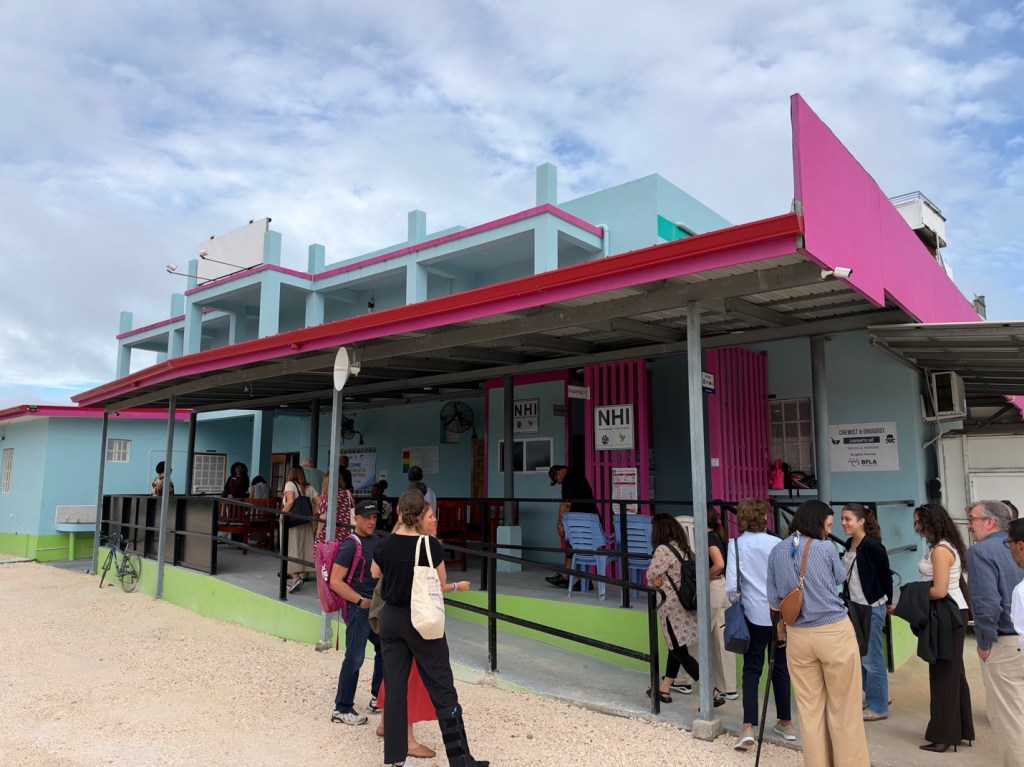
BFLA Main Clinic
I went to the southern part of the country by a van passing mostly uncultivated land with scrub vegetation on it. There is also extensive marshland, and the one cemetery I passed was built with coffins being interred above ground as in New Orleans. Moderately high hills appeared the further south I went. I went through three police checkpoints, which were checking for drugs being smuggled up towards the Belize City.
I had the goal of visiting a banana plantation where BFLA brings its services directly to the farm workers living there. However, heavy rains caused flooding, and the roads were impassable, so instead I went to a small mobile clinic that had been set up on the grounds of a community church in the village of Stann Creek where three outreach workers from BFLA and the Ministry of Health together were seeing women and children from that neighborhood for a variety of health conditions. The nurse and the outreach workers visit this particular village three times a year.
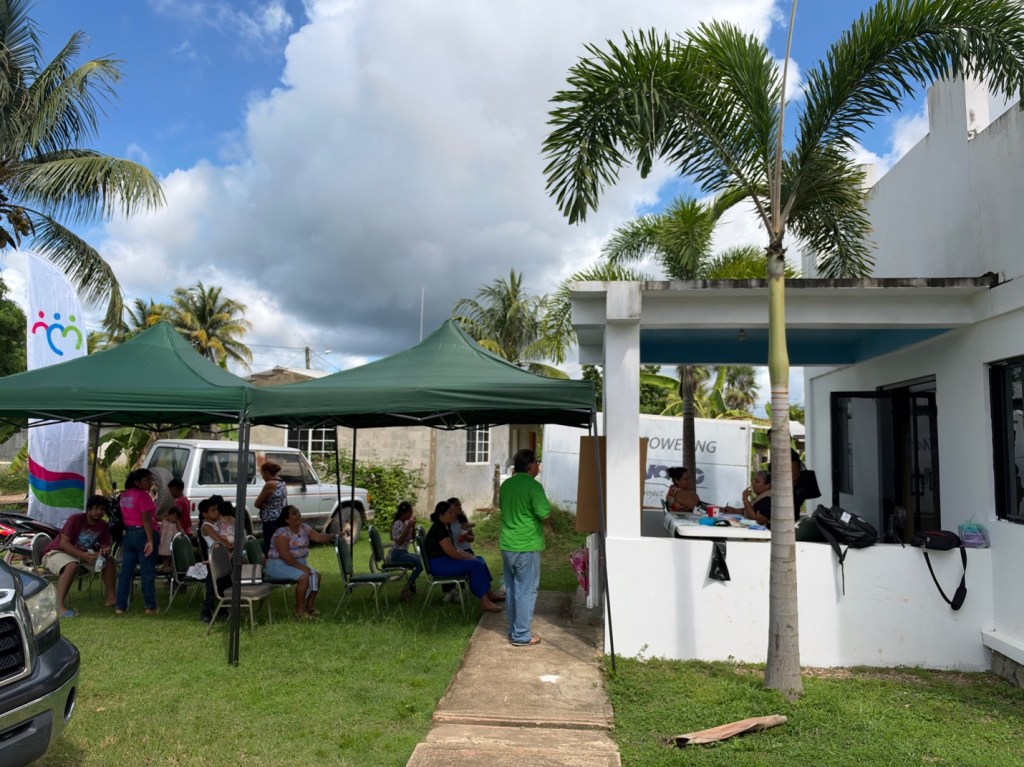
Stann Creek Mobile Clinic
The women had walked there or had ridden motorcycles, often walking for over half an hour. The clinic was set up under a tent with a back office inside the church’s community building, so that the provider could see women in private. The chickens in a neighboring coop let us know they were there. Laundry hung from neighboring buildings and was hastily removed when the rains came.
The nurses did screening for blood pressure and weight; two women were referred for additional care for hypertension. There were no Pap smears being done that day. Blood is drawn to check for cholesterol, among other conditions, like diabetes. There was a presentation in Spanish by the outreach worker on breast self-exams, to which the women paid rapt attention. The children were all very well behaved while this was going on.
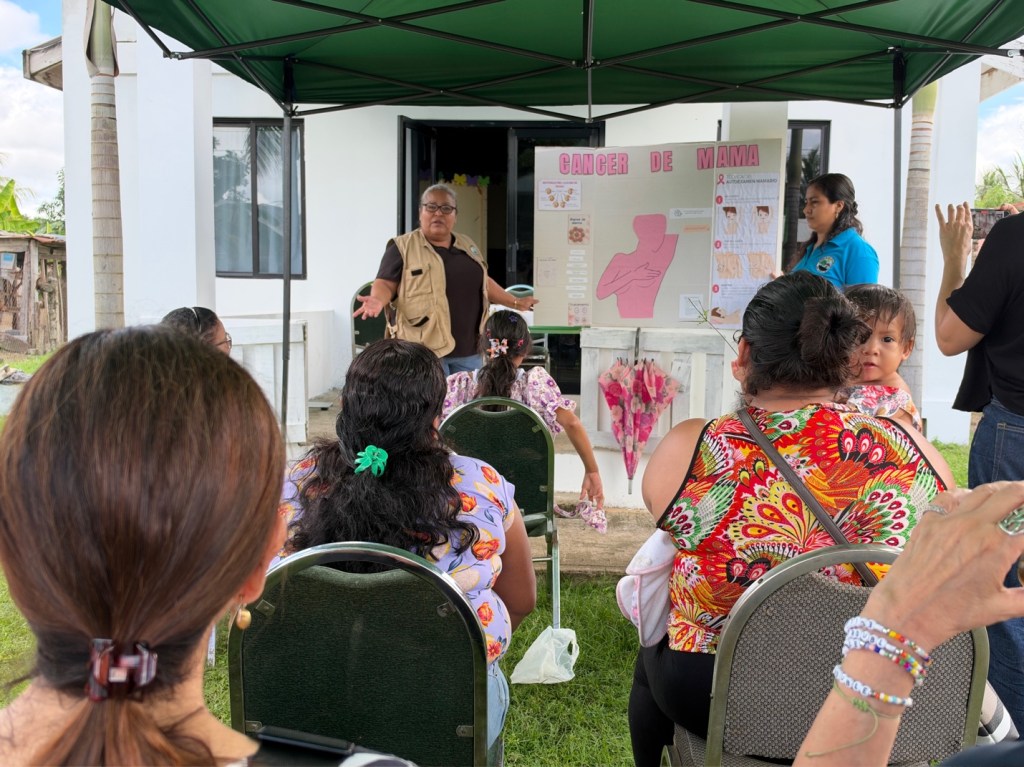
Breast Self-Exam Workshop
We then visited a nearby BFLA clinic in Dangriga where BFLA is creating a soap making subsidiary, starting in February. Another social enterprise venture! They had a machine donated by the government, and they will be making bars of soap as well as hand soaps, shampoos, conditioners, and liquid hand cleansers. They hope to supply hotels with bottles of shampoo and conditioner, as well as supplying clinics and doctors’ offices with hand wash.
Conclusion
BFLA is an impressive organization doing much needed work under difficult circumstances. I am proud to be supporting them.
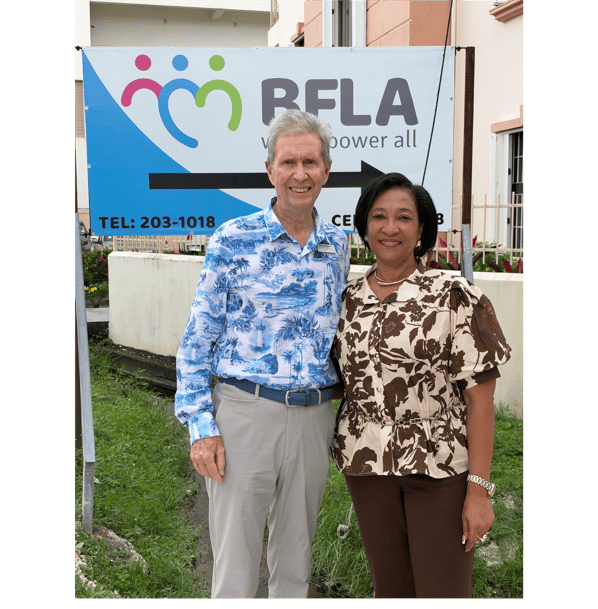
ACS with BFLA Director Joan Burke

